I agree we need a strong foundation, but my question is when do we take a step forward? At what point can we start taking that foundation and move into new areas of thought, theology, and understanding? And how do we do it in a way that is by and large acceptable to greater Heathenry, which is not centralized and no one group has authority over another?
Reconstruction as a method is vital and important, and I don't think many people argue, but when it starts becoming almost "scriptural" (if it isn't in available lore, or some academic mentioned it, then it isn't Heathen) we start having problems. I am not talking about making stuff up (which rapidly the term UPG is turning into, and why I don't like using the term) but taking that solid foundation that is both explicit (like something found in a saga like the Eyrbyggja Saga or a procedure in Njal's Saga) and implicit (ideas of Honour, Ethics, etc.) into new areas. Take what we are pretty sure was done and thought and apply it/them in a new way. When do we get to new Myth? When do we get to new theological ideas? New accepted ideas that fuel new ritual and procedure?
Our ancestors pulled from their memories precedent to tackle issues that was before them. For example, There is a large lake that is the major source of water and food, they regularly honour it ... and calm it with ritual and offers. Suddenly there are more drownings and a flood, to their logic they have somehow upset the Lake. So they do a special ritual, and do their best to satisfy the Lake Jotun/Vaettir. No more drownings occur, and everyone is seeing white Herons (or some unusual bird) which they take to mean a good omen.
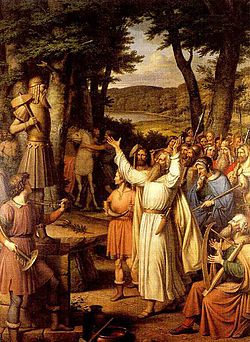
Now, they are in a drought a few years later that no one including the oldest of Elders have experienced. They call in a Spaekona or Volva (or equivalent) or local "holy person" who tells them the Mountain is holding back the rain because it has never been honoured or recognized like the Lake has, even though it has been there longer. The Elders all grant that they haven't. What to do, they don't know what is important to the Mountain. So they essentially go to some significant part of the mountain, and do the same ritual as they do the Lake, offering things that they think honour the mountain and will soothe it. It rains a little, so they are doing something right. So they try something they do with the harvest that honours Freyr and give him "wife" from the village (this could be a statue, a corn dolly, or an actual sacrifice of a maiden depending on the group). The rains come quickly!
So new ritual and new thought comes into their lives. Every five years they give honour to the mountain and give him a new wife.
My point is our ancestors took the past and adapted and innovated. There validation came from their environment, through dream, omen, and similar. They had no "book" to tell them what worked or what didn't. Because we are "writing based" too many think that if it is not done exactly like they think is done in some Saga or what some Academic or scholar says is right ... that it is not valid and therefore not Heathen. This is essentially "scriptural." These "reconstruction-alists" (these people who only accept as valid what you find in the Lore, totally my own term and referring to people who think like this) look at a Kindred in the desert that has adapted understood Heathen ritual forms but in a way suitable to their environment as invalid because it doesn't follow the Freyr Ritual found in the Lore. What is, and is not, Heathen is being determined by text not locally.
… or these “reconstruction-alists” claim that when a Tribe redefines the role of say Thyle into different areas beyond Sumbel, combining it with Lawspeaker, and a parliamentarian from Robert's Rules into something that is a good fit for their Tribe, that since this is not what Unferth did in Beowulf that tribe calling this new "job" a Thyle is wrong, invalid, and therefore *not* Heathen.
Reconstruction as a method is important, and we need to build from it as a foundation, but when does modern environment and experience to take us into new areas of thought, concept, and theology? How does the Internet figure into our Religion? Is it Odin's domain? or Loki's? How do Freyja or Frigga (or any of the Goddesses) grow in a modern feminist world? Where is the new Myth to adapt this? How do we Heathens grapple with ethical concepts of say cloning? These are just a few examples.
I know not all who claim to be Reconstructionist are this way, but I have encountered many who have moved beyond reconstruction as a method, into the texts (primary and secondary) are deciding validity. I think my primary problem is that Authority is being derived from academic and scholarly places instead of from within Heathenry itself.


